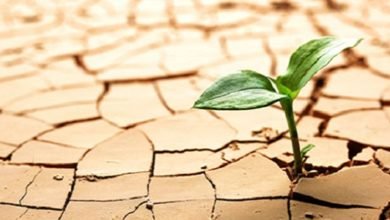
Two Views of Our Future
Biodiversity, Consumerism, Deforestation, Economics, Food Shortages, Global Warming/Climate Change, Population, Society, Soil Erosion & Contamination, Water Contaminaton & Loss, peak oil — by Earth Policy Institute June 27, 2012
by Lester R. Brown, Earth Policy Institute
No previous civilization has survived the ongoing destruction of its natural supports. Nor will ours. Yet economists look at the future through a different lens. Relying heavily on economic data to measure progress, they see the near 10-fold growth in the world economy since 1950 and the associated gains in living standards as the crowning achievement of our modern civilization. During this period, income per person worldwide climbed nearly fourfold, boosting living standards to previously unimaginable levels. A century ago, annual growth in the world economy was measured in the billions of dollars. Today, it is measured in the trillions. In the eyes of mainstream economists, our present economic system has not only an illustrious past but also a promising future.
End of an Era
Biodiversity, Consumerism, Deforestation, Economics, Global Warming/Climate Change, Society, Soil Erosion & Contamination, Water Contaminaton & Loss — by George Monbiot
So now what do we do to defend life on Earth?
by George Monbiot: journalist, author, academic and environmental and political activist, United Kingdom.
It is, perhaps, the greatest failure of collective leadership since the first world war. The Earth’s living systems are collapsing, and the leaders of some of the most powerful nations – the US, the UK, Germany, Russia – could not even be bothered to turn up and discuss it. Those who did attend the Earth summit last week solemnly agreed to keep stoking the destructive fires: sixteen times in their text they pledged to pursue “sustained growth”, the primary cause of the biosphere’s losses(1).
The efforts of governments are concentrated not on defending the living Earth from destruction, but on defending the machine that is destroying it. Whenever consumer capitalism becomes snarled up by its own contradictions, governments scramble to mend the machine, to ensure – though it consumes the conditions that sustain our lives – that it runs faster than ever before.
Comments (4)How “Sustainability” Became “Sustained Growth”
Biodiversity, Consumerism, Deforestation, Economics, Global Warming/Climate Change, Population, Society, Soil Erosion & Contamination, Water Contaminaton & Loss, peak oil — by George Monbiot June 24, 2012
Editor’s Preamble: In a prevous editorial life, I used to make a decent attempt at commentary for these large international events — those organised with some pretention towards shifting us onto a ’sustainable path — but I no longer have the energy for it. Pinning our hopes on politicians’ plans for ‘greening the economy’ is a bit like using your digital alarm clock. The alarm rings, then we hit ’snooze’ periodically — with a multi-year interval between wake up calls…. All these meetings seem to do is cement a mindset of ‘leave it to the experts’, whilst these ‘experts’ obfuscate with shifting nuances of language. The results coming out of Rio+20 are certainly disappointing, but in no way surprising. It is said, and it’s not hard to believe, that a large industry can do more damage in a couple of hours than the average individual can make in their entire lifetime. While ‘consumers’ are generally targeted as the main culprits (it’s very convenient for industry, and the politicians that pander to them, to pass the blame to the little guy), incentivising or mandating change in industry is therefore of the upmost importance. (Indeed, some industries need to disappear entirely, whilst other new carbon-neutral/positive industries need to begin.) These industries do ’serve’ consumers, however, so no matter what way we look at it, the end user is at least partly responsible for the resource use, emissions and pollution of the industries whose products and services they avail themselves of. But, due to the mass consolidation of industry over the last few decades, it has become increasingly difficult for consumers to have a choice — and even more difficult to really know the environmental cost of the products and services we use, as what we know about these usually far-removed industries is only what they tell us. Political frameworks/policies, industry, media and advertising largely shape social structures — so consumers can ultimately end up being captive participants in a system not of their making. These players will never reinvent the system for us, so we should quit waiting for that to happen.
~~~~~
The Rio Declaration rips up the basic principles of environmental action.
by George Monbiot: journalist, author, academic and environmental and political activist, United Kingdom.
In 1992 world leaders signed up to something called “sustainability”. Few of them were clear about what it meant; I suspect that many of them had no idea. Perhaps as a result, it did not take long for this concept to mutate into something subtly different: “sustainable development”. Then it made a short jump to another term: “sustainable growth”. And now, in the 2012 Earth Summit text that world leaders are about to adopt, it has subtly mutated once more: into “sustained growth”.
The Mendacity of Hope
Biodiversity, Conferences, Consumerism, Deforestation, Economics, GMOs, Global Warming/Climate Change, Population, Society, Soil Erosion & Contamination, Water Contaminaton & Loss — by George Monbiot June 23, 2012
The summits which promise to save the world keep us dangling, not mobilising.
by George Monbiot: journalist, author, academic and environmental and political activist, United Kingdom.
Worn down by hope. That’s the predicament of those who have sought to defend the earth’s living systems. Every time governments meet to discuss the environmental crisis, we are told that this is the “make or break summit”, upon which the future of the world depends. The talks might have failed before, but this time the light of reason will descend upon the world.
We know it’s rubbish, but we allow our hopes to be raised, only to witness 190 nations arguing through the night over the use of the subjunctive in paragraph 286. We know that at the end of this process the UN secretary-general, whose job obliges him to talk nonsense in an impressive number of languages, will explain that the unresolved issues (namely all of them) will be settled at next year’s summit. Yet still we hope for something better.
This week’s earth summit in Rio de Janeiro is a ghost of the glad, confident meeting 20 years ago. By now, the leaders who gathered in the same city in 1992 told us, the world’s environmental problems were to have been solved. But all they have generated is more meetings, which will continue until the delegates, surrounded by rising waters, have eaten the last rare dove, exquisitely presented with an olive leaf roulade. The biosphere, that world leaders promised to protect, is in a far worse state than it was 20 years ago(1). Is it not time to recognise that they have failed?
Comments (2)What Will Rio+20 Bring?
Alternatives to Political Systems, Biodiversity, Conferences, Consumerism, Economics, Global Warming/Climate Change, Society, Soil Erosion & Contamination, Village Development, Water Contaminaton & Loss, peak oil — by Samuel Alexander June 21, 2012

In a few days the international community will be meeting in Rio de Janeiro, to hold the most significant environmental conference since the Rio Earth Summit of 1992. As the planet’s ecosystems tremble under the weight of overconsumption, this conference surely provides one of few remaining opportunities for governments to take environmental issues seriously.
Will the world’s leaders dare to think beyond the growth paradigm that lies at the root of our environmental crises? Will they be bold enough to constrain the overconsumption of natural resources or even acknowledge the problem of stagnating oil supplies? Sadly, history provides little grounds for confidence. What is more likely is that the conference will simply warm the climate further through an exchange of hot air disguised as genuine commitment.
Comments (0)Rio+20: What Ecovillages Offer
Alternatives to Political Systems, Community Projects, Conferences, Consumerism, Eco-Villages, Economics, People Systems, Population, Presentations/Demonstrations, Society, Village Development, peak oil — by Albert Bates
It is the start of Rio+20, the UN Conference on Sustainable Development, and the Global Ecovillage Network has a strong contingent here from all over the world. We have erected a dome at the People’s Summit in Cupala dos Povos (Flamingo Park) and are providing a “Speaker’s Corner” for ecovillages, Transition Towns, Occupy, and others to strut their stuff. So what is it that ecovillages and permaculture bring to this discussion?
The late philosopher Ivan Illich, in his 1974 book, Energy and Equity, observed that conventional wisdom would have it that “the well-being of a society can be measured by the number of years its members have gone to school and by the number of energy slaves they have thereby learned to command.” This conventional wisdom would seem to be now widely shared by both non-governmental organizations and UN intergovernmental agencies working on issues such as education, the rights of women and minorities, and indigenous peoples. Illich challenged it.
“The energy crisis focuses concern on the scarcity of fodder for these slaves,” he said. “I prefer to ask whether free men need them.”
Comments (3)Myth of Perpetual Growth is Killing America
Biodiversity, Consumerism, Deforestation, Economics, Food Shortages, Global Warming/Climate Change, Population, Society, Soil Erosion & Contamination, Water Contaminaton & Loss, peak oil — by Paul B Farrell June 15, 2012
Editor’s preamble: It’s refreshing and even somewhat reassuring when a major stock market website runs an article like the one below….
Everything you know about economics is wrong
![]() A stray dog stands on a rubbish dump at the seafront in Sidon, southern Lebanon. |
Yes, everything you know about economics is wrong. Dead wrong. Everything. The conclusions of economists are based on a fiction that distorts everything else. As a result economics is as real as one of the summer blockbusters like “Battleship,” “The Avenger” or “Prometheus.”
The difference is that the economic profession is a genuine threat, not entertainment. Economics dogma is on track to destroy the world with a misleading ideology.
Why? Because all economics is based on the absurd Myth of Perpetual Growth. Yes, all theories and business plans based on growth are mythological.
Comments (17)PRI Networking, the Value of Collaboration, and the Development of More PRI Education/Demonstration Projects
Aid Projects, Commercial Farm Projects, Community Projects, Consumerism, Demonstration Sites, Education Centres, Networking Sites, People Systems, Society, Urban Projects, Village Development — by Craig Mackintosh PRI Editor June 12, 2012

Do we segregate…?
Photos © Craig Mackintosh
Most of us are by now wholly cognizant of the fact that the global response to long-brewing trouble has been well short of timely or appropriate. The world as a whole, if I were to be brutally honest, is taking three steps backwards for every few inches it moves forwards. Wonderful moves towards sustainability are daily dwarfed by industrial and individualistic efforts in the opposite direction. There are, indeed, wondrous examples and tantalisingly positive suggestions and ambitions shining like little beacons of hope from various quarters worldwide, but most of the world’s population experience these as mere pleasant, but out of reach, distractions from their daily quest to survive. Whether it’s ’survival’ in the very real sense, scratching for food, water and firewood, or in the modernist sense of retaining some degree of sanity after too many hours at an unsatisfying and unnatural job (that’s only endured due to previous purchases ‘the system’ has pressured us into), either way there are too few people either willing or able to venture out of their very real personal worlds to run with concepts far removed from their daily lives.
In the permaculture camp, however, a great deal of positive work is being trialled and actioned, often independently, and, as such, painfully unnoticed.
Getting it noticed is a central part of the PRI’s work….
Comments (12)Foodscaping: Reap What You Sow
Courses/Workshops, General, Society — by Matthew Lynch June 11, 2012
I thought you might be interested in this short news segment which recently aired nationally on the ‘America Now’ news network in the USA, featuring yours truly:
Check out the lengthy disclaimer given by the TV hosts at the end of the segment (morbidly fascinating), though I especially like the permaculture plugs given by the reporter "look up your local permaculturist in the White Pages" and "or with a quick Google search, you can join the global Permablitz movement"….
Permaculture goin’ mainstream, one small news story at a time.
Since I have your attention, if you’re looking to take a PDC on Oahu’s North Shore this August, be sure to check out our upcoming course! (July 30 — August 12, 2012.)
Comments (6)Captive Animals
Biodiversity, Economics, Global Warming/Climate Change, Society — by George Monbiot
How Natural England became the servant of the landed classes.
by George Monbiot: journalist, author, academic and environmental and political activist, United Kingdom.

Listening to the National Farmers’ Union, the Countryside Alliance and the Country Land and Business Association, you could be forgiven for believing that the only people who live in the countryside are farmers and landowners.
In fact, there are 9.8 million people living in rural England (defined as settlements with fewer than 10,000 inhabitants). Of these, 140,000 people are full-time farmers, or the business partners, directors and spouses of full-time farmers. In other words, they constitute 1.4% of the rural population (and 0.3% of the total population).
Comments (1)The Resurgent Aristocracy
Biodiversity, Society — by George Monbiot June 6, 2012
Rural policy is once again the preserve of the elite, and wildlife and people suffer as a result.
by George Monbiot: journalist, author, academic and environmental and political activist, United Kingdom.
I might have solved a minor mystery. Last week, after a public outcry(1,2), the government dropped its proposal to spend our money on capturing buzzards and destroying their nests to help pheasant shoots(3). The scheme was championed by Richard Benyon, the minister charged, as one of David Cameron’s little jokes, with protecting wildlife and biodiversity. Benyon is the owner of a huge stately home called Englefield House, and the 20,000-acre walled estate that surrounds it(4). The estate employs gamekeepers to stock it with pheasants and kill the animals that might eat them.
The rationale for this proposal was the weakest I have ever seen. The government intended to find new ways of persecuting buzzards, on the grounds that “anecdotal evidence” suggests that their predation of pheasants “can be significant at the local site level.”(5) No reference was given. Research held by DEFRA shows that just 1-2% of young pheasants are taken by all birds of prey(6). So where did the “anecdotal evidence” come from?
Comments (3)Ted Trainer and the Simpler Way
Biodiversity, Consumerism, Deforestation, Economics, Education, Food Shortages, Global Warming/Climate Change, Nuclear, Population, Society, Soil Erosion & Contamination, Water Contaminaton & Loss, peak oil — by Samuel Alexander June 5, 2012
Editor’s Note: To follow, I think, is a very important look at Ted Trainer’s work — one that broaches an oft-avoided but critically essential conversation. I must confess to only having read a single article from Ted Trainer previously, which I posted here, but from that article, and the document below, I sense that similar thought processes in my own experience, and Ted’s, have led to the similar conclusions. Some of my thoughts along similar lines are evidenced here, here, here, here, here, here and here, as a few of many examples. In short, permaculture must be taken to mean ‘permanent culture’, and not just ‘permanent agriculture’ (as some would have it, as evidenced by the wrath I endure whenever we discuss economics and politics on this site…). And, for those interested, in regards to the ‘debate’ between Ted, Rob Hopkins and Brian Davey (see section 6), I empathise and agree with each perspective, as it happens. For me they’re all different sides of the same form, but none of the points raised eliminate the need for a systemic rework of socio-economic political systems. Rather, Rob and Brian’s perspective just emphasise how much work we have to do to get people on board and working to the same fruitful end. The final quoted passage from Theodore Roszak (bottom of article below) tells me we’ve come to similar conclusions, where he states the need for tangible living examples of happy low-tech implementations of how to live — the very purpose behind my work in creating the Worldwide Permaculture Network, to showcase and inspire people with what is possible, so permaculturists can share their own learning journey and insights into the how of it.
1. Ted Trainer and the Simpler Way
For several decades Ted Trainer has been developing and refining an important theory of societal change, which he calls The Simpler Way. His essential premise is that overconsumption in the most developed regions of the world is the root cause of our global predicament, and upon this premise he argues that a necessary part of any transition to a sustainable and just world involves those who are overconsuming accepting far more materially ‘simple’ lifestyles. That is the radical implication of our global predicament which most people, including most environmentalists, seem unwilling to acknowledge or accept, but which Trainer does not shy away from and, indeed, which he follows through to its logical conclusion. The Simpler Way is not about deprivation or sacrifice, however; it is about embracing what is sufficient to live well and creating social and economic systems on that basis. This essay presents an overview of Trainer’s position, drawing mainly on the most complete expression of it in his latest book, The Transition to a Sustainable and Just World, an analysis which is supplemented by some of his more recent essays. My review is designed in part to bring more attention to a theorist whose work has been greatly underappreciated, so the review is more expository than critical. But in places my analysis seeks to raise questions about Trainer’s position, and develop it where possible, in the hope of advancing the debate and deepening our understanding of the important issues under consideration. I begin by outlining the various elements of The Simpler Way and proceed to unpack them in more detail.
Geoff Lawton’s Zaytuna Farm Video Tour (Apr/May 2012) – Ten Years of (R)Evolutionary Design
Animal Housing, Biodiversity, Biological Cleaning, Bird Life, Building, Commercial Farm Projects, Compost, Conservation, Consumerism, Courses/Workshops, Demonstration Sites, Education, Education Centres, Energy Systems, Fencing, Food Forests, Food Plants - Annual, Food Plants - Perennial, Irrigation, Land, Livestock, Nurseries & Propogation, Plant Systems, Potable Water, Rehabilitation, Society, Soil Conservation, Structure, Trees, Village Development, Waste Systems & Recycling, Water Harvesting — by Craig Mackintosh PRI Editor June 1, 2012

Paradise Dam, April 2012, from the now-climaxing food forest
Photos © Craig Mackintosh (unless otherwise indicated)
Zaytuna Farm Video Tour, duration 41 minutes
Note: Switch YouTube player to HD if your internet connection allows
Having spent the last few years seeking to establish and assist projects worldwide, and hearing some readers requesting more info on our own permaculture base site, I thought it high time I take a moment away from promoting other projects to shine a little light on our own work!
It had been a long time since I last visited Zaytuna Farm. Arriving in April 2012, more than two and a half years after my September 2009 visit, I was somewhat taken aback…. Back in 2009 the farm could somewhat be described as an unruly child — full of energy and enthusiasm, and flush with life, but not at all mature. Now, as I see Geoff Lawton’s vision for the property being played out more fully, we could compare the farm to more of a blossoming and beautiful teenager, still fresh in youth, but demonstrating a clearer sense of direction.
Geoff’s long term strategies are becoming evident, and it really is a sight, and site, to behold!
Comments (22)Food Forests and Earth Stewardship
Food Forests, Food Plants - Perennial, Plant Systems, Society — by Angelo Eliades May 26, 2012
In Nature, all things are interconnected to each other, and in permaculture we strive to understand the relationships that comprise the ecological web of life. Through understanding the relationships in an ecological system, we can model these to build similarly sustainable systems.
Of all the ecological relationships we might encounter, possibly the most important (to us) is the relationship of humanity to the rest of Nature. One of the greatest realisations that come from studying permaculture is that we are not above Nature, we are part of it, an integral part of the system so to speak, and when we assume out rightful and proper place, our relationship to Nature changes profoundly.
The aim of this article is to examine humanity’s relationship to Nature, how it has changed over time, how we can reclaim our unique ecological niche, and the benefits gained from reclaiming our rightful place in the ecological scheme of things.
Comments (14)John D. Liu’s Green Gold Documentary – How the West (and East, North and South!) Could Be Won
Aid Projects, Community Projects, Conservation, Consumerism, Dams, Deforestation, Demonstration Sites, Food Shortages, Global Warming/Climate Change, Irrigation, Land, Plant Systems, Population, Potable Water, Regional Water Cycle, Rehabilitation, Society, Soil Biology, Soil Conservation, Soil Erosion & Contamination, Swales, Terraces, Trees, Village Development, Water Contaminaton & Loss, Water Harvesting — by Craig Mackintosh PRI Editor May 24, 2012
As most of our readers will know, John D. Liu caught a vision years ago, and, thankfully, he ran with it. We’ve shared John’s excellent media work before (see here and here), and today have the pleasure of doing so again….
This new video, Green Gold, was first aired last month on Dutch TV, and will be shared at the Rio+20 United Nations Conference on Sustainable Development (to a captive audience of influential representative delegates during their dinner!), which is being held next month in Brazil (20-22 June 2012).
The video takes you to China, Jordan (more background on the PRI Jordan project here), Ethiopia, Rwanda and Bolivia, and features the PRI’s own Geoff Lawton (and a cameo appearance from Nadia!), who adds impetus and technical know-how to John’s impressive toolbox, as well as the ‘Permaculture Princess‘ (Princess Basma bint Ali of Jordan), and others.
It’s the story of healing landscapes at scale, and, with it, restoring life, livelihoods, security and a future.
Comments (6)


