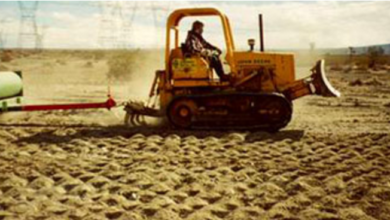
Geoff Lawton Talks to ABC Radio About Dryland Salinity
Land, News, Regional Water Cycle, Rehabilitation, Salination, Soil Biology, Soil Composition, Soil Conservation, Soil Erosion & Contamination, Structure, Water Harvesting — by Craig Mackintosh PRI Editor March 29, 2010
A couple of weeks ago ABC Rural’s ‘Bush Telegraph’ radio show featured an interview with Dr. Christine Jones about how to deal with the major problem of dryland salinity. Her ‘radical’ thoughts on it prompted a heated response from Mick Fleming, a former principal research scientist with CSIRO Land and Water, who was ‘gobsmacked’ with her ideas, and countered with his own.
Geoff found the discussion of great interest, and ended up being interviewed by Michael Mackenzie of ABC radio on the issue – it makes for a very interesting listen.
Click play below to hear the talk:
ABC Talks to Geoff Lawton on Dryland Salinity Comments (7)Please Get Behind Our Efforts to Demonstrate Sustainable Development and Relief for Chile Quake/Tsunami Victims
Aid Projects, Building, Community Projects, Conservation, Demonstration Sites, Eco-Villages, Education Centres, Energy Systems, Ethical Investment, Irrigation, Networking Sites, News, People Systems, Society, Village Development, Waste Systems & Recycling, Water Harvesting — by Grifen Hope March 20, 2010
Editor’s Preamble: Permaculturists famously endeavour to ‘turn the problem into a solution’. At the moment we have a tremendous opportunity to apply this principle in wonderful, productive ways in disaster-hit Chile. The quake-tsunami combo that hit on February 27, 2010 has created a void just begging for sustainable relief and re-development. Grifen Hope, who writes below and who leads out at Ecoescuela El Manzano, a partner organisation to the Permaculture Research Institute, is well positioned to fill that void with all kinds of permaculture goodness – in the form of low-cost environmentally friendly buildings, improved sanitation and nutrient cycling through construction of composting toilets, water harvesting systems and in education in home garden design, etc. Grifen’s already established and successful project and his national contacts make this a particularly significant opportunity, to not only directly help people in great need at this time, but to also offer more holistic and community centred alternatives to local and national government – alternatives with far greater short and long term potential than those offered by the scores of contractors seeking to cash in on misery. PRI Australia feels so strongly about assisting Grifen with his noble ambitions, that we’re putting forward the first AU$1,000 donation. Both PRI Australia and PRI USA are taking donations for this cause (people in the U.S. will want to donate through PRI USA, to take advantage of their tax-exampt non-profit status). In the interests of transparency, PRI USA will take 5 percent of donations to cover administration and the work that had to be done to facilitate the legal aspects of sponsoring this project – but that 5% will help PRI USA develop its own projects). PRI Australia will pass 100% of donations to the project in Chile. Additionally, as we feel this work deserves significant exposure, and as we seek to ensure that valuable permaculture relief work gets noticed at the highest levels, to attract further governmental support for future disasters worldwide, PRI Australia and myself (Craig Mackintosh) will share the costs for myself to go to Chile to cover and report on Grifen’s work via photographs, writing and video. I would like to take this opportunity to ask people to get behind this in whatever way they can. Donations, large or small, will all assist in what is the very best form of aid work. Perhaps ask your employer to match your donation – many will. Additionally, people with contacts in government, aid agencies and other NGOs are invited to share this page with them. Thanks in advance to the worldwide permaculture community for getting behind this work. You never know – in the future you may be the recipient of such assistance.
Update: ‘Letters from Chile‘ reports from Craig are coming in. Check them out!
| Donate via PRI USA (USA residents)* Other non-paypal methods of donating here |
|
| Donate via PRI Australia (rest of world)* Other non-paypal methods of donating here |
|
| *Please be sure to click on the ‘Add special instructions to seller’ link, and then type ‘CHILE’ in the field provided, to ensure these fund are correctly diverted. | |

El Manzano in Transition – Towards Community Resilience, by Design
by Grifen Hope of Ecoescuela El Manzano
Comments (3)Letters from Zaytuna – Mini Swales in Urban Permaculture Gardens
Biological Cleaning, Conservation, Irrigation, Regional Water Cycle, Swales, Urban Projects, Water Harvesting — by Patrick Blampied March 16, 2010
Swales hold and soak water that would otherwise get away without doing anything positive for your property. In fact it can cause problems – like soil erosion.
Swales are critical features in the design of any permaculture project but most of the applications you see on youtube are broad acre properties and many people might think that’s what they’re reserved for. Not true!
Small swales are very useful in urban gardens and can double as footpaths. Have a look at my video of Geoff Lawtons kitchen garden, which is a great example of how to improve your urban garden.
Much Love! Pat
Comments (9)My Experience of Permaculture in Guatemala
Community Projects, Demonstration Sites, Education Centres, Food Forests, Food Plants - Annual, Food Plants - Perennial, Plant Systems, Project Positions, Rehabilitation, Trees, Water Harvesting — by Kevin Mascarenhas February 7, 2010
The Ijatz cooperative is possibly the best demonstration of the transformative power of permaculture in Guatemala. The site, in San Lucas Toliman near Lake Atitlan, was purchased at low cost since the parish council considered the land to be of low value. Previously, it was a swampy bog inundated with refuse and flood water from the surrounding hills.
In classic permaculture style, within the problem lay the seeds of the solution. The deforestation due to conventional agriculture in these surrounding hills has caused soil erosion and during the rainy season much of this rich volcanic black top soil is washed downstream. This annual bounty has been redirected through the Ijatz site using a sequence of channels and sink holes, which in turn slows the water flow enabling the nutrient rich humus to be captured and stored on site. The earth has been moulded to create slopes, edges and contours essential for increased growing opportunity.
Comments (15)Jawaseri School Garden Project, Jordan
Aid Projects, Community Projects, Conservation, Courses/Workshops, Demonstration Sites, Developments, Eco-Villages, Education Centres, Food Forests, Food Plants - Annual, Food Plants - Perennial, Food Shortages, Irrigation, Land, Nurseries & Propogation, People Systems, Plant Systems, Rehabilitation, Trees, Urban Projects, Village Development, Water Harvesting — by Craig Mackintosh PRI Editor February 6, 2010
Just as I was leaving Jordan, after making the Greening the Desert II update video, another little project was just getting underway – the Jawaseri School Garden project. A few people have emailed pictures of progress over the last few months and I’ve combined these with Geoff’s narration from the PRI home base in Australia, to give you all a bit of an idea what’s happening there. May it inspire you to do similar where you are!
Permaculture education should be in every school, everywhere. If it was, I believe most of the world’s problems could be solved within a decade.
Comments (6)Letters from Sri Lanka – Sarvodaya Builds Sri Lanka’s First Eco-Village
Aid Projects, Biological Cleaning, Building, Community Projects, Demonstration Sites, Eco-Villages, People Systems, Potable Water, Society, Village Development, Waste Systems & Recycling, Waste Water, Water Harvesting — by Craig Mackintosh PRI Editor February 4, 2010
Part VII of a series – If you haven’t already, please read Part I, Part II, Part III, Part IV, Part V and Part VI before continuing. This series is part of my work for the Sustainable (R)evolution book project.

One of 55 eco-friendly homes nestled amongst newly established gardens
An hour or so south of the Sri Lankan capital of Colombo is the fishing district of Kalutara. Although only one of many regions hit by the 2004 Tsunami, post-disaster relief efforts here were unique in that Sarvodaya determined to use the situation to create Sri Lanka’s first eco-village.
Comments (11)Micro-Hydro for a Slovak Village
Community Projects, Energy Systems, Urban Projects, Village Development, Water Harvesting — by Craig Mackintosh PRI Editor January 23, 2010

A turbine with a 21 kWh generating capacity is the centrepiece of
a little village in the mountainous north central region of Slovakia
The village of Necpaly sits at 510 metres above sea level, on the eastern edge of the Necpalská Valley, in the Turiec region in the mountainous north of landlocked Slovakia. The area is filled with rolling hills and cascading valleys framed by mountain ranges peppered with deer, wild pig and bear. And, noteworthy for this particular article, the area boasts abundant flows of crystal clear water.
Comments (7)Letters from Sri Lanka – Sarvodaya’s Home Gardens
Aid Projects, Community Projects, Conservation, Demonstration Sites, Eco-Villages, Education Centres, Energy Systems, People Systems, Village Development, Waste Systems & Recycling, Water Harvesting — by Craig Mackintosh PRI Editor January 16, 2010
Part VI of a series – If you haven’t already, please read Part I, Part II, Part III, Part IV and Part V before continuing. This series is part of my work for the Sustainable (R)evolution book project.
A coconut shell is an excellent, biodegradable planter.
The coir (husk fibre) is extracted and mixed with soil to become a potting mix
with particularly good water retention capacity (the fibre reduces evaporation).
All photographs © Craig Mackintosh
The world’s largest water harvesting earthworks has transformed Sri Lanka, or at least large parts of it, from aridity to lushness. This mainframe design provides biological resources that villagers can use to maximise biodiversity for personal and environmental health. In similar fashion the ‘mainframe design’ of the ‘invisible structures’ of Sarvodaya’s community network provide avenues for the free flow of permaculture information to help achieve this goal. The good news is that many villagers are making use of these resources and this potential, despite constant attempts by Big Agri to lure them, through offers of free product samples and demonstrations, into chemical dependency.
Comments (12)Rosella Waters Earthworks, Phase I, Part B
Aquaculture, Biological Cleaning, Conservation, Dams, Demonstration Sites, Earth Banks, Education Centres, Food Forests, Gabions, Irrigation, Land, Material, Natural Swimming, Rehabilitation, Roads, Soil Conservation, Swales, Water Harvesting — by Kym Kruse January 9, 2010
![]() The Mushroom Dam overlooking the beach area |
It’s taken a while to find the time to sit down and report on Part B of our earthworks here at Rosella Waters, near Cairns in far North Queensland. Phase I Part A was documented whilst the process was taking place. This latest update however will rely on memory and hurried notes made during the process, together with numerous photos. Large excavations such as the two large dams we constructed in part A are considerably easier to direct and far less time consuming than the finer detail work using smaller machinery as we experienced in putting in Part B.
Comments (6)Anupam Mishra: The Ancient Ingenuity of Water Harvesting (Video)
Conservation, Food Shortages, Global Warming/Climate Change, Irrigation, Regional Water Cycle, Water Contaminaton & Loss, Water Harvesting — by Craig Mackintosh PRI Editor January 5, 2010

India is a country where water shortages have become so acute that the failed monsoon rains in 2009 had people literally killing each other over buckets of water, and tensions are still rising. (See this video also.) In many places cities are receiving less than half the water their populations need to meet basic requirements, and the constant bickering between individual states often breaks down into violent clashes.
Comments (1)Yeomans’ Pioneer Demonstration Site to Be Turned into Housing Estate
Conservation, Demonstration Sites, Irrigation, Land, News, Rehabilitation, Soil Biology, Soil Conservation, Structure, Water Harvesting — by Craig Mackintosh PRI Editor December 19, 2009
One of the most influential people in sustainable agricultural systems development is the late P.A. Yeomans. Yeomans went against the contemporary fertility-in-a-bottle school of thought to develop ‘keyline’ concepts of land management that work in harmony with natural land features (working with contours), to maximise water harvesting in the landscape, minimise soil erosion and build lasting soil fertility. His observations and practice led him to design and develop the keyline plow, a deep chisel plow that maximises water infiltration and soil aeration – setting up conditions that soil macro and microorganisms can flourish in – but that doesn’t overturn the soil, with its associated destruction of soil structure and life, as other plows do.
The ABC just ran an interesting spotlight (video – or transcript here if you prefer) where we learn that one of Yeomans’ properties, ‘Yobarnie’, in Richmond, north of Sydney, is facing ‘development’ that would turn this important historical demonstration site into a housing estate. In the 1950s and ’60s the site attracted busloads of people on weekend tours where observers could see the transformation his methods effected and learn about their implementation.
Comments (3)Greening the Desert II – Final
Aid Projects, Biological Cleaning, Compost, Conservation, Demonstration Sites, Education Centres, Food Forests, Food Plants - Perennial, Fungi, Irrigation, Plant Systems, Rehabilitation, Salination, Soil Biology, Soil Conservation, Trees, Water Harvesting — by Craig Mackintosh PRI Editor December 11, 2009
The Greening the Desert II video I shared with you recently was edited in Jordan. Now that I’m back at my desk again I’ve had time to edit it slightly. I’ve added the original five-minute Greening the Desert clip in to the front of it, to ensure viewers have context for Part II (and we’ve also had requests for both to be made available together), as well as cut a few minutes out of Part II to keep it flowing a little better. You can not only watch online below and embed on your own websites (click for embed code at top right of video screen), but it’s also available for download, so those who’d like to have a ‘hard copy’ to circulate are welcome to download, burn to disk or transfer to USB key, etc., and circulate freely.
Download: You’ll see the option to download the 913 megabyte MP4 file at bottom right side of this page.
YouTube: The video can also be watched on YouTube, in four segments, here, here, here and here.
Greening the Desert II (including Part I) – Greening the Middle East
(Duration: 36 mins)
Tips for playing: If it’s slow to load, turn off High Definition (HD) on the player.
If you still have problems, click play (on low or high def) and then after it’s started,
click on pause. The video will then continue to buffer into your computer.
Play once fully loaded.
I would like to take the opportunity to thank Kelly Kellogg at this juncture. Kelly donated initial funding that enabled the purchase of the land for the Jordan Valley Permaculture Project site (aka ‘Greening the Desert – the Sequel’). But, upon watching the Greening the Desert Part II video, Kelly was inspired to donate an additional $20,000. These gifts are very encouraging to us as we try to solve problems at source (teach a man to fish…). Others who may feel inspired to donate to help us move this work forward faster can do so here.
A little background on the video follows:
Comments (28)Keyline Swales – a Geoff Lawton/Darren Doherty Hybrid
Biological Cleaning, Conservation, Earth Banks, Land, Soil Conservation, Swales, Water Harvesting — by Campbell Wilson November 30, 2009
A swale on Zaytuna Farm – © Craig Mackintosh
(Remaining images below © Cam Wilson.)
Geoff Lawton and Darren Doherty are the two highest profile people in Australian Permaculture when it comes to broadacre water harvesting earthworks. They’ve both had success in some very tough environments, and yet it’s interesting that their styles are quite different, particularly when it comes to infiltration strategies.
This article is a short comparison of their approaches, along with an idea I had recently for amalgamating the benefits of each.
Comments (19)Tigger Does Mullumbimby Community Gardens
Comedy Break, Community Projects, Demonstration Sites, Education Centres, Swales, Urban Projects, Water Harvesting — by Craig Mackintosh PRI Editor November 13, 2009
Regular readers will have noted a couple of posts – here and here – covering the new and developing Mullumbimby Community Gardens project underway not so far from Zaytuna Farm (about half an hour east, if travelling by car, or a day’s ride on horseback).
Readers of those posts will have seen the panoramas I took to try to keep track of progress. Well, despite clambering up onto their shipping-container-come-tool-shed to take those shots, I always thought that I wasn’t quite high enough to really do the place justice.
So, this time I thought I’d go along with a pogo stick in hand! I had to use a super-fast shutter speed, as travelling at these heights does make for shaky hand-holding of the camera. After several attempts, and not a few bumps and bruises, I managed to get a couple of publishable shots.

Taken after the fifth bounce, when I had a bit of a rhythm going
Letters from Melbourne – Cam and Jesse’s Urban Retreat
Conservation, Demonstration Sites, Food Forests, Food Plants - Annual, Food Plants - Perennial, Plant Systems, Rehabilitation, Soil Biology, Soil Conservation, Structure, Trees, Urban Projects, Water Harvesting — by Craig Mackintosh PRI Editor November 10, 2009

An urban hideaway managed by Cam, Jesse and Yarrow Wilson
(Yarrow was taking a break for this shot)
All photographs © Craig Mackintosh

On my recent trip to the Bill Mollison/Geoff Lawton course in Melbourne, that I forced myself to miss so I could go on site visits in the area, Cam Wilson kindly offered to be my guide – giving me very knowledgeable insights into the places we visited. As well as the Dalpura Farm site we just posted about and giving me the heads up on Angelo the Wizard, covered in this post, Cam took me to see the very cool stuff he’s doing on an urban block currently under his expert control in the ‘burbs of Melbourne.
Comments (8)