Soil Food Web Course with Dr. Elaine Ingham
Compost, Courses/Workshops, Fungi, Rehabilitation, Soil Biology, Soil Conservation — by Owen Hablutzel November 8, 2009
October 30 – November 1, 2009
Orella Ranch, Gaviota Coast, California.

A wise person once said that soil is not only more complex than we know, it is more complex than we can ever know! The good news is humans have lately achieved a level of practically applicable knowledge and experience in soil biology to be absolutely capable of massive, positive impacts on sustainable soil use world-wide! It is undoubtedly true that we’ll never know everything, but no matter – we already know enough to get very, very busy!
Comments (10)The Full Belly Project
Aid Projects, Food Plants - Annual, Food Shortages, Rehabilitation, Soil Conservation, Soil Erosion & Contamination — by Craig Mackintosh PRI Editor November 3, 2009
George Washington Carver (1864-1943) was a man worthy of respect. Born into slavery (his mother was purchased), he lived and died as a black man in an age of racial segregation. He was lucky enough, however, that his owners were a decent couple, who helped him to read and write, and ultimately ended up raising George as their own son (George, his sister and mother were all stolen and resold at one point — the original owner was only ever able to retrieve George).
George was encouraged to study and learn, and that he did — until he became one of the greatest agricultural researchers of his age.
Comments (1)Market Gardening and Catching Carbon
Fungi, Rehabilitation, Soil Biology, Soil Composition, Soil Conservation, Structure — by Hugh Lovel October 4, 2009

After driving all night from my North Georgia market gardens I arrived just before seven in the morning at the Indianapolis hotel where the ACRES U.S.A. Convention was to be held. The lines at the hotel desk were so long I left my colleague, Lorraine Cahill, to check in while I headed for the restaurant. I needed a steaming mug of coffee and a bite of breakfast to start my day. Otherwise I was in danger of fading away. Growing market veggies for 26 weeks for restaurants, markets and box subscribers had, thankfully, just come to a close before driving all night to reach America’s most unforgettable and inspiring convention. I didn’t want to miss a minute of it, but I had a booth to set up when the trade show opened and I needed more push than I had at the moment.
Comments (1)Keyline Plowing with Compost Tea Application
Land, Rehabilitation, Soil Biology, Soil Composition, Soil Conservation, Structure — by Benjamin Falloon September 16, 2009
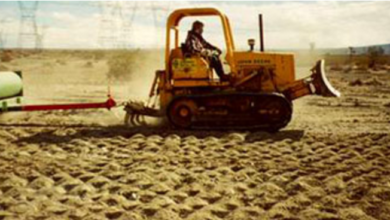
This article forms part of a series concerning the development of methods of compost tea application via the keyline plow which are being published on taranakifarm.com.
Part I: Introduction
Employing the methods developed by P.A. Yeomans, keyline pattern plowing is a proven component in the job of revitalizing degraded soils. The plow performs deep ripping with minimal plant disturbance. At its most basic this offers many benefits, including opening compacted soils (without destructive tillage), breaking up the hard pan, allowing moisture and oxygen to re-activate soil life, thus restoring fertility. When used in concert with controlled grazing or mowing through a managed cycle, top soil is built rapidly.
In the related field of soil biology, Dr Elaine Ingham (the eminent biologist) has made breakthrough discoveries studying soil life and developing methods of brewing compost tea. Her work promotes the pressing need to re-populate our damaged soils with the necessary microbial biota. Without the essential micro organisms our soils cannot develop balance. A balanced soil offers fertility, that builds through the exchange for nutrients that is the tireless work of soil life. A multitude of symbiotic connections evolved in harmony.
Comments (10)Six Ways to Save the Planet with Mushrooms
Fungi, Plant Systems, Rehabilitation, Soil Biology, Soil Composition, Soil Conservation, Soil Erosion & Contamination, Structure — by Craig Mackintosh PRI Editor July 28, 2009
No, we’re not talking about your average portobello mushroom here, found on pizzas the world over. The topic of this discussion is:
mycelium noun the white threadlike mass of filaments forming the vegetative part of a fungus
Whilst sounding tiny in both size and significance, it is not:
Is this the largest organism in the world? This 2,400-acre (9.7 km2) site in eastern Oregon had a contiguous growth of mycelium before logging roads cut through it. Estimated at 1,665 football fields in size and 2,200 years old, this one fungus has killed the forest above it several times over, and in so doing has built deeper soil layers that allow the growth of ever-larger stands of trees. Mushroom-forming forest fungi are unique in that their mycelial mats can achieve such massive proportions. – Paul Stamets, Mycelium Running
Watch the clip to learn more about these fascinating fungi – organisms totally ignored by industrial agriculture, but which are incredible allies as we seek to decontaminate and restore soils and other habitat.
Duration: 00:18:18
Comments (9)Phosphorus Matters II – Keeping Phosphorus on Farms
Compost, Fungi, Rehabilitation, Soil Biology, Soil Composition, Soil Conservation — by Marcin Gerwin July 23, 2009
Editor’s Prelude: Peak Phosphorus barely registers alongside it’s more gregarious, attention-getting bigger brother, Peak Oil. Yet, the implications are even more dramatic. While both peaks are associated with massive food shortages, unmitigated Peak Phosphorus would easily win the award for best disaster.
The latest research tells us that Peak Phosphorus is an issue we cannot afford to ignore any more:
… a global production peak of phosphate rock is estimated to occur around 2033. While this may seem in the distant future, there are currently no alternatives on the market today that could replace phosphate rock on any significant scale. New infrastructure and institutional arrangements required could take decades to develop.
While all the world’s farmers require access to phosphorus fertilisers, the major phosphate rock reserves are under the control of a small number of countries including China, Morocco and the US. China recently imposed a 135% export tariff on phosphate rock essentially preventing any from leaving the country. Reserves in the U.S. are calculated to be depleted within 30 years. Morocco currently occupies Western Sahara and its massive phosphate rock reserves, contrary to UN resolutions. – Western Sahara Resource Watch
Marcin, the podium is yours.
Keeping Phosphorus on Farms – by Marcin Gerwin (the sequel to ‘Closing the Phosphorus Cycle‘)
![]() Lupines. Photo: Carol Mitchell/Flickr |
“Next to clean water, phosphorus will be one the inexorable limits to human occupancy on this planet” wrote Bill Mollison in Permaculture: A Designers’ Manual more than 20 years ago (1). It is that important that we design phosphorus recycling into our food systems. Phosphorus is an essential element for growing crops and no porridge, chocolate bar or cherry jam can be made without it.
Comments (7)Greywater Mulch Pits
Biological Cleaning, Compost, Conservation, Soil Conservation, Storm Water, Swales, Waste Water, Water Contaminaton & Loss, Water Harvesting — by Campbell Wilson May 20, 2009
by Cam Wilson, Forest Edge Permaculture
Greywater mulch-pits provide an excellent solution when re-using greywater on your garden – they are cheap to construct, they improve the quality of water entering your soil and after some time provide you with valuable compost. They’re very easy to construct too. You basically just dig a hole, wack in some 100mm ag-pipe and then fill it up with nice chunky mulch.

Keyline Design – Mark IV
Biological Cleaning, Conservation, Dams, Earth Banks, Gabions, Land, Limonia, Rehabilitation, Roads, Soil Conservation, Soil Erosion & Contamination, Surveying, Swales, Terraces, Water Harvesting — by Darren Doherty March 16, 2009
‘Soil, Water & Carbon for Every Farm’ – Building Soils, Harvesting Rainwater, Storing Carbon
by Abe Collins & Darren Doherty
Introduction
Keyline Design was first developed by the great Australian, P.A. Yeomans (1904-1984), in the late 1940s & 50s initially as a practical response to the unpredictable rainfall regime he found on his new property, ‘Nevallan’, to the west of Sydney, New South Wales, Australia. Soil Conservation, as developed by the US Army Corp of Engineers was the predominant practice of the time and for a time Yeomans was influenced by this, though soon found some deficiencies with the pattern of water flow its application expressed. Yeomans went on to devote the rest of his life to the promotion, research and development of Keyline Design and in doing so was labelled by Permaculture co-originator Bill Mollison as "…one of Australia’s greatest patriots… ".
Influenced by the likes of prominent organic agriculture figures in Andre Voison, Friend Sykes, Newman Turner & Louis Bromfield (among many others!) Yeomans has been attributed with being the 1st person to accelerate soil formation through the stacking of methods, overturning the myth that it took 1,000 years to create an inch of topsoil. Yeomans proclaimed that "…the landman’s job is not so much to conserve soil as it is to develop soil, to improve his soil and to make it more fertile than it ever was…".
Comments (0)Report on our Iranian Consultancy Trip of December 2008
Aid Projects, Compost, Conservation, Courses/Workshops, Dams, Developments, Earth Banks, Gabions, Land, News, Plant Systems, Rehabilitation, Soil Conservation, Soil Erosion & Contamination, Swales, Trees, Water Harvesting — by Geoff Lawton February 24, 2009
Editor’s Note: Iran has been making headlines in the media a great deal over the last few years. Here’s a side to the story you don’t normally get to hear, as experienced by our own Geoff Lawton.

We are applying Permaculture techniques to restore the landscape
in the hottest place on the planet
In December 2008 it was our great pleasure and honour to be invited to Iran to work for the Forest Rangeland Watershed Management Organisation, originally formed in 1928 (see Word doc on their work here). We were working with different departments of the organisation, like the Sand Dune Fixation Department that was formed in 1958 for the Bureau of Desert Affairs. All of this falls under the central government’s main organisation of Jihad Agriculture Ministry. We were invited to teach a 10-day Permaculture course focusing mainly on desert rehabilitation.
Comments (9)Street Orchards for Community Security
Biological Cleaning, Community Projects, Conservation, Food Forests, Food Plants - Perennial, Land, Potable Water, Regional Water Cycle, Rehabilitation, Roads, Soil Conservation, Storm Water, Trees, Urban Projects, Village Development, Waste Systems & Recycling, Waste Water, Water Contaminaton & Loss, Water Harvesting — by Brad Lancaster January 19, 2009
© Brad Lancaster, www.HarvestingRainwater.com
![]() Fig. 24.The heat island effect. An excessively wide, exposed, solar-oven-like residential street in Tucson, Arizona absorbs the sun’s heat during the day like a battery, then radiates it out at night. This local warming effect has raised summer temperatures in Tucson by 6°F (3°C) since the 1940s, which contributes to global warming since the higher temperatures result in people using air conditioners more, which are powered by electricity generated through the burning of coal. Note that no shade trees are planted in the public right-of-way along the street, leaving street and sidewalk baked. All runoff is drained off site leaving the development dehydrated. Reproduced with permission from “Rainwater Harvesting for Drylands and Beyond, Volume 1" |
My view of public streets was radically changed when I heard ecovillage designer Max Lindigger tell a story of an insightful walk he took with his grandfather. “Look there,” said his grandfather, pointing to condominiums being built on the once forested slopes above his village in the Swiss Alps. “That’s where we grew and gathered food during the war. The forests were common land, a reserve of community resources. What commons remain? Where will we grow and gather our food in the next catastrophe?”
I then looked at my Sonoran desert city of Tucson, Arizona and asked myself, “Where are my community’s forests, our commons? Where would we get our food in times of need?”
Comments (5)Phosphorus Matters
Compost, Food Shortages, Soil Composition, Soil Conservation, Soil Erosion & Contamination — by Marcin Gerwin January 14, 2009
Part One: Closing the Phosphorus Cycle
|
|
It might sound ridiculous, but for every container of bananas, coffee, tea or cocoa imported, we should send back a shipment of a fluffy, earth-like smelling compost. Why is that? With each container of food we import nutrients taken up by plants from the soil. We import calcium, potassium, magnesium, boron, iron, zinc, molybdenum, copper and many others. One of the essential elements imported in food is phosphorus. For every ton of bananas we import 0.3 kg of phosphorus, for every ton of cocoa it’s 5 kg and for ton of coffee it’s 3.3 kg of phosphorus. Tea is a bit more complicated, because the amount of phosphorus depends on the origin of tea – for example in 1 ton of tea leaves harvested in Sri Lanka there are some 3.5 kg of phosphorus, while tea from South India contains 6.6 kg of phosphorus (1).
Comments (6)The Rise and Predictable Fall of Globalized Industrial Agriculture
Conservation, Consumerism, Economics, Food Shortages, Global Warming/Climate Change, Population, Soil Conservation, peak oil — by Craig Mackintosh PRI Editor October 27, 2008
Today I’d like to introduce you to a (well written and beautifully presented) report, titled – ‘The Rise and Predictable Fall of Globalized Industrial Agriculture‘ (55 page, 2.4mb PDF). The title says it all. Should you be concerned? Yes.
Your concern, however, should not be that the globalised industrial agribusiness model will collapse – this is not only inevitable, but also necessary, and, might I add, desirable – the focus should instead be on when and how it will fall.
Let me explain.
If you were to ask the Average Joe what is the largest contributor to global warming, many will say cars, trucks and aeroplanes – or coal fired power plants. While these are large contributors, they cannot compete with the largest, yet mostly overlooked contribution from our present system of farming and global food trading. Global warming is primarily due to agriculture. Indeed, much of the above-stated contributors are merely essential aspects in maintaining the globalised agricultural model:
Comments (0)Humanure Handbook – Free Download
Compost, Conservation, DVDs/Books, Fungi, Potable Water, Rehabilitation, Soil Biology, Soil Conservation, Soil Erosion & Contamination, Waste Water, Water Contaminaton & Loss — by Craig Mackintosh PRI Editor September 18, 2008
With chapters like ‘Crap Happens’, ‘Deep Shit’ and ‘A Day in the Life of a Turd’, this is sure to be an interesting book, albeit possibly not one to read over lunch?
With this wonderful substance piling up in all the wrong places (after all, we’re running out of clean water, and yet we’re crapping in it…), this taboo topic deserves a lot more attention than it gets. The book is now into its 3rd Edition.
- Download E-book ($10)
- Buy a hard copy ($25)
- Download Chapter by Chapter (free)
- Read Online (free)
Soil – Our Financial Institution
Biological Cleaning, Conservation, Rehabilitation, Soil Biology, Soil Composition, Soil Conservation, Soil Erosion & Contamination, Structure — by Craig Mackintosh PRI Editor August 7, 2008
Soil – the substance you walk on, build on, and live from – provides your food, clothing, and even the air you breathe. It gives warmth, shelter, and the goods you possess. Soil is, I believe, a substance that is under-acknowledged, and also under attack, and its misuse is contributing greatly to the excessive release of CO2 into our atmosphere – making it a large contributor to global warming. Therefore, I felt it high time we came to its defense. Here goes.
Small is Bountiful
Food Shortages, Population, Soil Conservation, Soil Erosion & Contamination — by George Monbiot July 30, 2008
by George Monbiot – journalist, author, academic and environmental and political activist. Originally published in the Guardian, 10 June 2008
I suggest you sit down before you read this. Robert Mugabe is right. At last week’s global food summit he was the only leader to speak of “the importance … of land in agricultural production and food security”.(1) Countries should follow Zimbabwe’s lead, he said, in democratising ownership.
Of course the old bastard has done just the opposite. He has evicted his opponents and given land to his supporters. He has failed to support the new settlements with credit or expertise, with the result that farming in Zimbabwe has collapsed. The country was in desperate need of land reform when Mugabe became president. It remains in desperate need of land reform today.
Comments (1)