PRI
Get our news via RSS!
Or, subscribe to posts by email. Enter address:
 

Fresh From Our Contributing Authors What's a "contributing author"?

Of Permaculture and Pastoralism: Heroes and Villains?

People Systems, Society — by Alice Gray May 24, 2013


State tractors ploughing in the barley crops of the Al Hawashleh tribe (our
hosts) outside Qasr A Sir in March of this year

Having recently finished teaching my third PDC course in the Bedouin village of Qasr A Sir in the Negev desert of Israel, I feel inspired to raise this controversial issue with the permaculture community. I would like to state from the outset that I do not have any clear answers, and intend this article as a discursive piece to inspire debate and reflection rather than a conclusive set of arguments.

The question is as old as ‘civilization’ itself, dating back to the dawn of agriculture in the Middle East around 10 000 years ago, and the great cultural transition that began then. It is the same question that permaculture seeks to answer, perhaps the single most important question facing humanity: how should we use the land? In short it is a question of culture and the clash of cultures, of narratives, possession, dispossession and dominance, of resource rights, of nomadic culture vs. sedentary culture; of hunter-gatherer lifestyles vs. pastoralist lifestyles vs. agrarian lifestyles. Perhaps the question is a little bit more complex than that in fact, and could be better framed as: how should we relate to cultures that have a different concept of land ownership and resource usage from our own? Living and working in the midst of a Bedouin village that is undergoing a forced transition from pastoralism to settled living within a modern industrialized state, this question cannot help but crop up.

Click for more…

Comments (4)

This is Water

Society — by Stefan Boone

Tips to help you have perspective.

Comments (2)

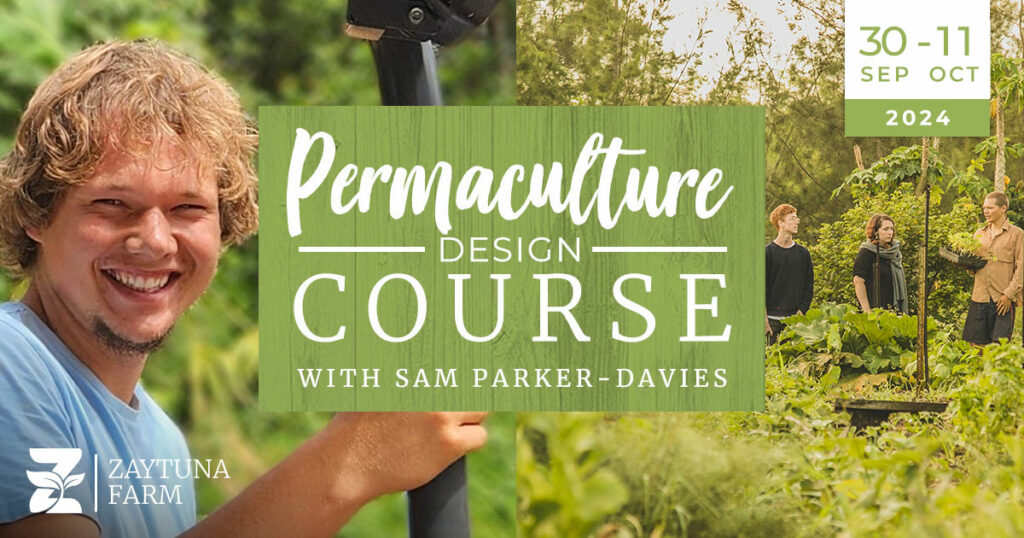
The July 22nd, 2013, 10-Week Internship Program at PRI Zaytuna Farm

Courses/Workshops — by Bonnie Freibergs

Starting July 22nd PRI Zaytuna Farm will have its last 10-Week Internship program for 2013. Features of the program include:

  • Detailed design and consultancy
  • Surveying
  • The Permaculture Earthworks Course
  • The Permaculture Project Establishment Course
  • Farm forestry
  • Nursery systems
  • Animal systems
  • Fencing systems
  • Main crops
  • Food forests
  • Fuel wood production
  • Kitchen gardens
  • The Urban Permaculture Design Course
  • The Learn how to Teach Permaculture Creatively Course
  • Garden agriculture
  • Energy systems
  • Waste systems
  • Aquaculture
  • Community group establishment
  • Composting systems
  • The Sustainable Soils Management Course

PRI Zaytuna Farm has been running this particular Internship program since the start of 2010. It focuses on the need to gain experience as quickly as possible so that, after taking the Permaculture Design Certificate course, you can move into a professional permaculture career in design, consultancy and teaching in both international consultant and project work. It is a hands on learning experience. Alongside Geoff and others, Interns are involved in every aspect of Zaytuna Farm and they come away from this program with the confidence and courage to implement their own solutions.

Click for more…

Comments (0)

The Never-Spotted Leopard

Biodiversity, Society — by George Monbiot

Are repeated sightings of non-existent big cats evidence of a yearning for a wilder life?

An extract from Feral: searching for enchantment on the frontiers of rewilding, by George Monbiot, published in the Guardian, 22nd May 2013.

by George Monbiot

The setting was unimprovable. Across the fields, Maiden Castle, a turretted fortress of living rock, clawed at the sky. Beyond it was the village of Wolf’s Castle – Casblaidd – distinguished as one of only twenty places in which Owain Glyndwr was born (he died in quite a few as well), and said to be the spot where the last wolf in Wales was killed. Below us a tangled willow carr smothered the valley.

“This gap in the hedge here: that could be where it came through. Then it came down the bank, sauntered across the road and disappeared into the scrub.”

I peered into the woods on the other side of the lane. The trees were hooded with ivy. Their mossy trunks sprawled over the ground, or leant on each other, dark-cowled, like drunken friars. Beneath them was an impenetrable thicket of brambles and ferns.

“You wouldn’t see him in there, would you?”

“You have no doubt about what it was?”

Michael Disney looked around and shrugged.

“It’s not an issue for me. I saw what I saw and that’s that. People can either believe it or not. I’m not trying to convince anyone.”

Click for more…

Comments (0)

Next-Generation Polycultures

Food Forests, Food Plants - Perennial, Plant Systems, Trees — by Eric Toensmeier May 22, 2013

Excerpted from Paradise Lot: Two Plant Geeks, One Tenth of an Acre, and the Making of an Edible Urban Oasis by Eric Toensmeier with contributions from Jonathan Bates, available from Chelsea Green January 2013. The book tells the story of our permaculture garden from design through co-evolution nine years down the road.

One spring day in 2009, I gave a garden tour to a young man from New York City who had a forest garden in his tiny front yard. In a ten-by-ten foot patch, he had planted an Asian persimmon and a full set of companions for nitrogen fixation, groundcover, and additional perennial foods. As we walked the garden, I pointed out many species, and we sampled some fruits and greens that he had never tasted before. Usually by the end of a tour, people say how impressed they are with our garden. But this young man had obviously read my books.

“So where are the polycultures?” he asked.

Click for more…

Comments (3)

Tamera, Portugal (John D. Liu Video)

Community Projects — by Craig Mackintosh PRI Editor

John D. Liu of the EEMP treats us to another look at permaculture solutions in application — this time with the Tamera project in Portugal.

Tamera is a peace research village with the goal of becoming “a self-sufficient, sustainable and duplicatable communitarian model for nonviolent cooperation and cohabitation between humans, animals, nature, and Creation for a future of peace for all." [1] It is also often called a “healing biotope." [2] Literally translated, "biotope" simply means a place where life lives. In Tamera, however, “healing biotope” is also described as a “greenhouse of trust,” “an acupuncture point of peace,” and “a self-sufficient future community." [2] It is located on 335 acres (1.36 km2) in the Alentejo region of southwestern Portugal. — Wikipedia

Comments (0)

A March against Monsanto is a March for Life and Freedom – 25th May 2013

GMOs — by Craig Mackintosh PRI Editor

Kudos to Dr. Vandana Shiva for kicking this off. Watch the videos to find out more, and get involved!

Click for more…

Comments (0)

The Valldaura ‘GreenFabLab’: Exploring the Frontier Between Technology, Environment and People

Community Projects, Courses/Workshops, Demonstration Sites, Education Centres — by Jamie Nicol

Permaculture and sustainability have rooted in the Spanish hills of Collserola near Barcelona and formed a partnership with a global project, the Green Fabrication Laboratory.

Innovation and creativity are part of the lifeblood of Barcelona. Picasso and Dalí began their artistic careers here and Gaudí and Miró have left their own mark on the progressive spirit of the city. The new Sustainability Centre of Valldaura follows this inventive character by offering the combination of technologies, old and new, to meet the tasks of an uncertain future.

Click for more…

Comments (0)

How to Build a Rocket Stove Mass Water Heater

Building, Energy Systems — by Craig Mackintosh PRI Editor May 20, 2013

With deforestation still moving ahead apace, dealing with the global demand for fuel wood is critical. Life without heat and hot water would be very unpleasant. Life without trees is impossible…. And to satiate our hunger for heat, richly biodiverse forests are being replaced with ’sterile’ monoculture tree plantations which give rise to tree diseases and other ecological vulnerabilities. The pressure for fuel wood is on in most parts of the world. Removing tree cover from the upper watershed is particularly damaging, but persistent demand can cause too many to shift the goalposts on how much should be allowed to remain….

Along with passive solar building designs, a rocket stove hot water heater can dramatically reduce the amount of wood used to heat a given amount of space, or a given amount of water — down to as little as a fifth as much as a regular fire. In this video Geoff Lawton takes you through the design of the rocket stove mass hot water heater that very efficiently provides reliable daily showers for the many students we receive at PRI Zaytuna Farm. This particular stove is specifically for heating water, but other designs can produce thermal mass space heaters as well.

Comments (10)

Poo-Free Self-Filling Duck Waterer

Animal Housing, Bird Life, Livestock — by Eric Seider


The mob

If any of you have had any experience with ducks, you’ll know that they produce and deposit enormous amounts of nutrient — aka duck poo. It usually ends up over everything they come in contact with. A general good practice is to keep them on water and then either fertigate (fertilize while irrigating) with that water and/or use them in connection with an aquaculture system (a fish pond with ducks produce more fish then without). But there are plenty of books and articles about what to do with ducks, so I’ll finish my digression and return to the subject at hand — that of a water source for ducks that they can’t poo in. Well, not without really trying to.

Click for more…

Comments (1)

Yet Another Use For the Humble Shipping Container – a Greenhouse

Building, Waste Systems & Recycling — by Amadeus DeKastle

Building a greenhouse from a shipping container and using it as an educational resource in Kyrgyzstan.

The shipping container is a symbol that is synonymous with growth. It is often used to ship plastic parts to China to be assembled, then shipped back as plastic water guns or whatever a dollar can buy at the discount shops. However, here in Central Asia, the shipping container is a resource to be used in any way imaginable. Kyrgyzstan is the furthest country in the world from any ocean port and as such, most of the containers that make it here, stay here. In fact, there are so many containers in the country that our largest bazaar is made almost entirely out of them — two stories tall, multiple kilometers wide, and employing over 50,000 people!

Shipping containers are basically designed to act like giant Lego blocks. In Kyrgyzstan, they are stacked up in all sorts of configurations to build bazaars, houses, or businesses. So it got me thinking: this resource is widely available in Kyrgyzstan, so why not try and see what else we can do with it? The school at which I volunteer was looking to add something to its science department, and since I’m a big permaculture supporter, I suggested we build a greenhouse out of a shipping container.

What follows is the journey that the school has taken to get to the “final” product we have today.

Click for more…

Comments (2)

Permaculture Design Course in Ivanovka, Kyrgyzstan

Courses/Workshops — by Amadeus DeKastle

What: Permaculture Design Course
Where: Location: Keiin Institute, Ivanovka, Kyrgyzstan (40 minutes from Bishkek)
When: June 24 – July 5, 2013
Teachers: Amadeus DeKastle and Calvin Lawrence

PDC Course Fees: Foreign price is 450 Euros, local price is 5000 som (see below for more information)
Included in Fees: PDC training, transportation from Bishkek to Ivanovka and back to Bishkek, morning and afternoon tea, and lunch.
Not Included in Fees: Accommodation, breakfast, and supper.

PDC Documents

Click for more…

Comments (0)

One Desert City Turns Stormwater into an Abundant Oasis using Green Infrastructure Practices

Community Projects, Conservation, Irrigation, Storm Water, Urban Projects, Water Harvesting — by Jennifer Wadsworth May 18, 2013

At 7:30 Sunday morning, April 21, 2013, people began to gather on a barren lot in downtown Phoenix, Arizona. The temperature was already climbing into the 80s and the lot’s bare dirt reflected both heat and light, making lingering uncomfortable. By 8:00 AM, more than 30 neighborhood volunteers, Youth Hostel guests, Green Living Co-op members, PDC and university students were on-site, eager to start the day’s activities. They were here to celebrate Earth Day by installing a green infrastructure retrofit project in the Garfield Historic District; an eclectic neighborhood that is part of the larger Arts District.

Click for more…

Comments (2)

My First WWOOF – Farming in Central America

General — by Serena Aurora

In Belize I took part in my first WWOOFing experience at Spanish Creek Farm. This film explains what WWOOFing is and how to take part in it. It also shows what work and activities took place at the farm. This includes; nursing a lamb, horse riding, looking after chickens, bamboo trimming, mulching, upkeep of plants and gardens, harvesting, cooking, furniture building and tool maintenance plus much more.

This film is created to promote the concept of WWOOFing and to open people’s eyes to the type of work that takes place on a farm.

I worked on the farm for two weeks. At the end of my stay I really appreciated the work that goes into running a farm. I really enjoyed working with the animals, it felt great to be in touch with nature and to know more about where my food comes from. Spanish creek farm is very well organised by the manager, Brooks. She is a fountain of knowledge and I learnt so much from her.

Comments (0)

La Nouvelle Trahison des Clercs

Economics, Society, peak oil — by George Monbiot

When scholars sell out, the consequences are grave.

by George Monbiot

In 1927 the French philosopher Julien Benda published a piercing attack on the intellectuals of his day. They should, he argued in La Trahison des Clercs (the treason of the scholars) act as a check on popular passions(1). Civilisation, he claimed, is possible only if intellectuals stand in opposition to the demands of political “realism” by upholding universal principles. “Thanks to the scholars,” Benda maintained, “humanity did evil for two thousand years, but honoured good.” Europe might have been lying in the gutter, but it was looking at the stars.

But those ideals, he argued, had been lost. Europe was now lying in the gutter, looking in the gutter. The “immense majority” of intellectuals, artists and clergy had joined “the chorus of hatreds”: nationalism, racism, the worship of power and war. In doing so, they justified and magnified political passions. Across Europe, scholars on both the left and the right had become “ready to support in their own countries the most flagrant injustices”, to abandon universal principles in favour of national exceptionalism and to proclaim “the supreme morality of violence”. He quoted the French anarcho-syndicalist Georges Sorel, who eulogised “the superb blond beast wandering in search of prey and carnage”.

Click for more…

Comments (0)